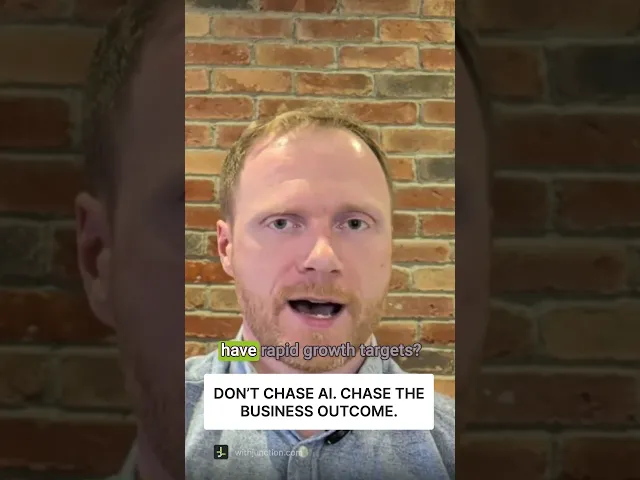
Mid-Market's AI Playbook: Episode 04 With Caleb Gawne
TLDR
Mid-market companies don't need more AI experiments. They need a playbook: start with a business goal, find the operational bottleneck, win small before going big, and know when AI isn't actually the answer. Caleb Gawne, CEO and co-founder of Kye, breaks down how mid-market leaders can move faster than enterprise, and why the window to do it won't stay open forever.
Date
07.08.26
Type
Interviews
Author
Field Notes
How mid-market companies can find the right AI opportunities, avoid scattered experimentation, and use automation to actually improve operations
Featuring Caleb Gawne, CEO and co-founder of Kye.
Mid-market leaders are being told to "do something with AI."
The pressure is real. Teams are experimenting with ChatGPT, Claude, Copilot, internal tools, and AI agents. Vendors are promising faster work, lower costs, better service, and more scalable operations.
But the challenge isn't whether AI belongs in your business.
It's knowing where AI actually creates business value and building toward that outcome instead of chasing the latest tool.
In this episode of Field Notes, Caleb Gawne- who has spent over a decade building technology for complex, manual industries like logistics, healthcare, insurance, and financial services, shares- a practical approach for turning AI from an experiment into an operational advantage.
1. Define the business outcome before you pick the tool.
As Caleb puts it: “AI for the sake of AI is a solution in search of a problem.”
Many AI projects fail before they start because they're driven by curiosity instead of business priorities.
Before evaluating tools, define the outcome you're trying to achieve.
Improve margins?
Reduce manual work?
Scale without hiring?
Respond to customers faster?
Stop billing errors?
Each objective leads to a different solution.
Without a clear business goal, teams adopt tools, generate activity, and struggle to show meaningful business impact.
Before you pick a tool, get clear on the number you're trying to move, and treat AI like any other investment: if it doesn't move that number, it's not a fit.
Action takeaway
Before approving any AI project, answer three questions:
What business metric are we trying to improve?
How will we measure success?
What bottleneck is preventing us from getting there today?
If you can't answer those questions, you're not ready to choose a tool.
2. Coordinate AI across the business. Don't let every team build their own island.

ChatGPT, Claude, and Copilot are excellent entry points. They help employees work faster and expose teams to what's possible with AI in their daily work.
But on their own, they can create individual gains, not organizational ones. The risk is that every department starts building its own prompts, workflows, and AI habits independently.
It's the modern version of the Excel spreadsheet problem. Instead of disconnected Excel files, you end up with disconnected AI workflows.
Caleb's warning is that this can quietly recreate the exact problem mid-market companies spent the last decade trying to escape: hundreds of disconnected spreadsheets, each one tuned to a single person or team. Instead of disconnected Excel files, you end up with disconnected AI workflows. Except it's happening faster, and it looks a lot cleaner on the surface.
Individual productivity improves. Organizational productivity often doesn't.
In businesses where the work is genuinely individual, like a small dev shop or a solo legal practice, that's fine.
Businesses that depend on coordination between sales, operations, customer service, finance, and supply chain need AI to improve shared processes, not just individual work.
Action takeaway
Assign clear ownership for AI adoption within the company. Typically, this works best as a top-down initiative driven by the C-suite.
Whether it's the CEO, COO, or another executive, someone should answer:
Where are we using AI today?
Where should we standardize?
Which workflows create value across multiple teams?
Treat AI like any other business capability, not a collection of personal productivity hacks.
3. Use small wins to build real momentum
Many companies jump straight to ambitious projects.
Replace the ERP, rebuild the CRM, automate everything at once. Caleb recommends the opposite.
Instead, start with a small, repeatable workflow that's already well understood across the business. These are typically tasks that are lower-value, well-defined, and already close to being documented.
Think:
Order entry
Quote generation
Administrative processing
Customer follow-up
Document handling
These are good places to start because you likely already understand the workflow well enough to isolate it. These make AI efforts easier to measure, easier to improve, and much lower risk.
Small wins create two important outcomes:
Leadership gains proof that AI delivers ROI.
Employees gain confidence that AI helps them do better work instead of replacing them.
That trust becomes the foundation for larger transformation later.
Action takeaway
Pick one workflow that:
Happens every day (repetitive)
Has clear inputs and outputs
Takes meaningful employee time
Improve that process first before expanding into larger initiatives.
4. Measure adoption first. Measure business impact second.
One mistake companies make is trying to calculate ROI before anyone is actually using the solution.
Caleb argues there's a much simpler sequence.
The first measure of success isn't financial. It's adoption.
Are people actually choosing to use the AI workflow instead of falling back to the old process?
If the answer is no, the technology doesn't matter. An AI solution that nobody uses creates zero business value.
Once adoption is happening consistently, shift your attention to business outcomes.
The mistake many companies make is measuring AI with generic metrics like prompts submitted, automations created, or hours "saved." Those numbers might look impressive, but they don't tell you whether the business is performing better.
Instead, measure AI against the metric you originally set out to improve.
If your goal was faster quoting, measure quote turnaround time.
If your goal was improving margins, measure margin.
If your goal was scaling without adding headcount, measure output per employee.
As Caleb puts it, success should always be measured against "the metrics that actually matter to your business, not an arbitrary measure."
Action takeaway
Every AI initiative should have two scorecards.
Adoption metrics
Are employees consistently using the new workflow?
Has the old process actually been replaced?
Is usage increasing over time?
Business metrics
Which KPI should improve?
What was the baseline?
Has that metric actually moved?
If adoption isn't happening, fix the workflow before worrying about ROI. If adoption is high but business metrics aren't improving, you may have automated the wrong problem.
5. Not everything needs AI.
Great businesses don't try to maximize AI. They try to maximize operational effectiveness.
Once you've measured the results of an AI initiative, ask an important question:
Did AI solve the problem, or did it simply expose a broken process?
As Caleb puts it, you'd rather have an organization of ordinary people working within well-designed systems than a team of geniuses operating without process.
AI should complement a well-run business, not compensate for a poorly designed one.
In Caleb's experience, the gains from operational transformation often break down like this:
40% AI
40% better automation and software (often built faster because of AI)
20% process redesign
He compares it to the shipping container, one of the most economically transformative inventions of the last 50 years. It wasn't intelligent. It was simply a standardized system that allowed everyone else to work more efficiently.
The same principle applies today: well-defined processes often create more value than adding more intelligence.
Action takeaway
Before expanding an AI project, ask:
Is the workflow clearly documented?
Are roles, rules, and handoffs well defined?
Are we solving the root cause, or adding AI to a broken process?
AI delivers the greatest value when it's improving a process that's already designed to succeed.
6. Move while the Middle-Market advantage still exists.
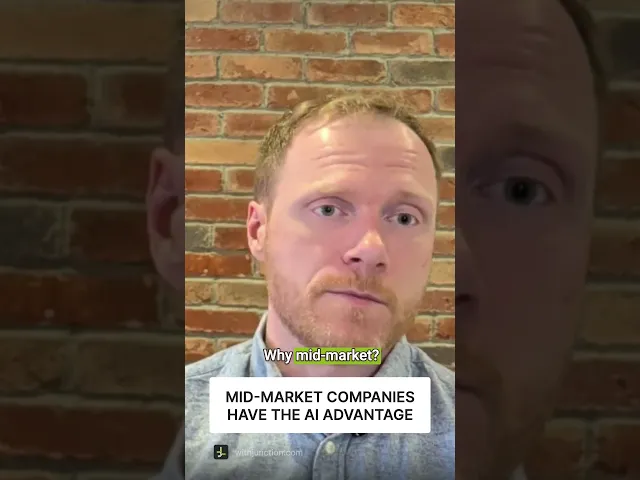
Large enterprises carry more resources, but also more friction: more systems, more approval layers, more organizational change required to shift how work gets done.
Mid-market companies have flatter structures and simpler tech stacks, so if ownership commits, they can move dramatically faster.
Caleb believes companies that begin building practical AI capabilities today have roughly a 2 to 3 year window where execution speed can become a competitive advantage.
Eventually, AI won't differentiate companies. Execution will. Waiting doesn't reduce uncertainty. It simply delays learning while competitors improve.
Caleb frames this through the venture lens of "default alive" versus "default dead."
Many mid-market companies have historically been default alive: grow a couple points a year, no urgency required. That's changing. Margins are eroding, market share is harder to hold, and financing is tighter. For those companies, adopting AI well isn't optional anymore. It's existential.
His estimate is that mid-market companies have roughly 2 to 3 years where early adoption creates a real, defensible advantage. After that, the field levels out, the technology becomes standard, and the edge shifts from whoever moves first to whoever executes best.
Action takeaway
Don't build a 3 year AI strategy before taking action.
Instead:
Choose one business problem.
Run a focused pilot.
Measure business impact.
Expand after proving adoption and ROI.
Treat AI adoption as a series of operational improvements, not a one-time transformation project.
Rapid fire from the episode
We got Caleb opinion on a few burning AI questions:
Most dangerous assumption companies make about AI: That it's a panacea, a silver bullet that solves everything with minimal effort to deploy.
Who should own AI inside a mid-market company: The CEO or COO.
Fastest way to tell if an AI initiative is working: First, people actually use it. Second, it improves the business metric it was designed to impact.
One skill that matters more because of AI: Management. Getting results from AI requires the same skills as leading people: breaking work into clear tasks, providing context, and evaluating outcomes.
Watch the Full Episode

In the full conversation, we discuss:
Where mid-market companies should start with AI
Why fragmented AI adoption creates new silos
Using small wins to build organizational confidence
Why not every workflow needs AI
How process design creates more value than most companies realize
Why mid-market companies may have a temporary competitive advantage
Final Takeaway
The useful question isn't "how do we use more AI?"
It's "where is the business getting stuck, and what would it be worth to fix it?"
The companies that win won't be the ones using the most AI.
They'll be the ones consistently solving operational bottlenecks, measuring the results, and scaling what works. AI is one tool in that process, not the strategy itself.
Stay Connected
Find us @withJunction on YouTube and LinkedIn for more Field Notes episodes, clips, and conversations on distribution, freight, and operations.
Want to be a guest or suggest a topic? Email us at info@withjunction.com.