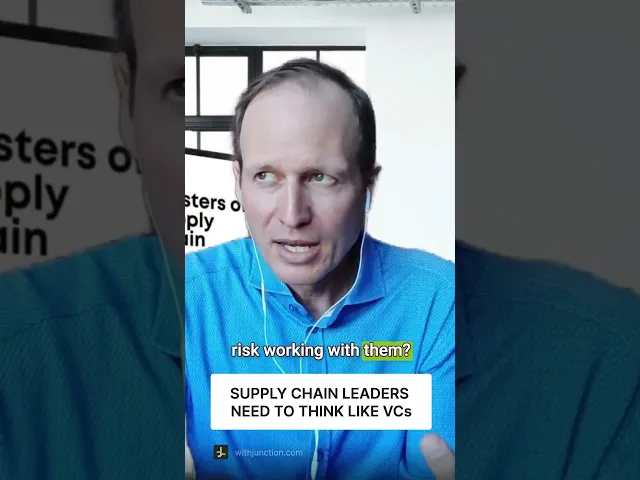
What Supply Chain Executives Are Really Talking About: Episode 03 With Florian Selch
TLDR
Supply chain executives are under pressure to move faster on AI, but the real challenge is not finding more technology. It is knowing which bets are worth making, which risks are manageable, and how to experiment without putting the operation in danger.
Date
06.30.26
Type
Interviews
Author
Field Notes
Field Notes: Episode 03 | What Supply Chain Executives Are Really Talking About: AI, Trust, and Tech Bets
How supply chain leaders can evaluate new technology, vendor risk, and operational change in an uncertain market
Featuring Florian Selch, CEO & founder of Masters of Supply Chain.
Supply chain leaders are being asked to move faster.
Boards and CEOs want to know what the organization is doing with AI, automation, analytics, and new technology. Vendors are promising better planning, faster execution, smarter decisions, and more connected systems.
At the same time, supply chain teams are still accountable for stability, service, cost, and execution.
That creates a hard operating question:
How do you move faster without turning the business into the test environment?
In this episode of Field Notes, Florian Selch shares what he is hearing from senior supply chain executives through Masters of Supply Chain, a peer-to-peer community built around practical conversations between operators, brands, and supply chain leaders.
The conversation gets into trust, vendor evaluation, end-to-end thinking, experimentation, and why “better forecasts” may not be the only answer in a more volatile world.
The Executive Takeaway
The point is not to chase every AI vendor.
The point is to build a better way to evaluate uncertainty: vendor maturity, operational risk, internal readiness, and where experimentation can happen without disrupting the core business.
For many companies, the real question is not, “Do we have an AI strategy?”
It is, “Do we have a disciplined way to learn which AI bets are worth making?”
1. AI Pressure Is Coming From the Top
One of the clearest themes Florian is hearing from executives is pressure from boards and CEOs.
The message is simple: do something with AI.
But that pressure lands differently in supply chain than it does in other parts of the business. Supply chain teams are responsible for keeping the machine running. They are not usually built around reckless experimentation. A failed test can mean missed shipments, broken workflows, poor service, higher cost, or frustrated teams.
That creates tension.
Executives do not want to miss a real opportunity. But they also do not want to make a big bet on immature technology that creates operational risk.
Questions to ask your team:
Where are we feeling pressure to “do something with AI”?
Is that pressure tied to a real business problem, or just a general fear of falling behind?
Which parts of the operation are safe to experiment around?
Which workflows are too close to core execution to use as a test bed?
What would a successful pilot need to prove in operational terms?
2: The Trust Gap Around New Technology
There is still excitement around AI and new technology, but there is also more skepticism.
A lot of companies have experimented. Some have seen promise. Others have been burned. And with so many new vendors entering the market, it is getting harder for executives to know who to trust.
That is where Florian sees peer learning playing an important role.
Analyst reports, conferences, and vendor case studies still have value, but they do not always answer the questions executives are quietly trying to ask.
What actually worked?
What broke?
Who is further along than they sound?
Who is still figuring it out?
What would you do differently?
That is part of what Masters of Supply Chain provides: a place where senior leaders can compare notes directly with peers facing similar decisions.
For many executives, the value is not just information. It is calibration. It helps leaders see what is real, what is still early, and where they may not be as far behind as they think.
3. Vendor Evaluation Needs a New Lens
The old technology buying process may not be enough anymore.
The traditional path was familiar: define requirements, issue an RFP, collect responses, compare vendors, choose the best fit.
That works better when the market is mature.
It works less well when the vendor is one or two years old, the category is still forming, and the technology is evolving quickly.
Florian makes the case that supply chain leaders may need to evaluate some technology partners less like a traditional software purchase and more like an investment decision.
That does not mean every operator needs to think like a venture capitalist. It means asking a different set of questions:
Who is behind the company?
What have they built before?
Do they understand the operational environment?
How are they funded?
Can they scale?
What happens if they cannot support the business six months from now?
For a supply chain leader, choosing an early-stage technology partner is not just a software purchase. It's an operational bet.
4. Automation Can Reinforce Silos If Leaders Are Not Careful
Supply chain is becoming more end-to-end.
Planning, procurement, inventory, logistics, customer experience, finance, and operations are all connected. A decision in one area affects the others.
That matters even more as teams adopt automation and AI.
If each function only automates its own workflow, companies risk rebuilding the same silos with newer tools. The tools may be faster, but the business may not be more connected.
The promise of supply chain technology is not just speed inside one department. It is better coordination across the business.
That requires leaders to look beyond their own function. A logistics leader needs to understand procurement. An inventory leader needs to understand transportation. A finance leader needs to understand operational execution.
Otherwise, automation may improve local efficiency while making end-to-end performance harder to manage.
Questions to ask your team:
Are we using AI to solve cross-functional problems, or just local workflow problems?
Where could automation reinforce the silos we already have?
Which functions need to be involved before we test this?
What upstream or downstream team will feel the impact first?
Are we optimizing one metric at the expense of the full operation?
5. Moving Faster Without Breaking the Operation
Florian’s advice to executives is not to wait for certainty.
The technology is changing too quickly. The market is not settled. The perfect plan may not arrive.
But the answer is not reckless experimentation either.
The useful path is creating environments where teams can test, learn, and fail in controlled ways. That is a different mindset for supply chain organizations, where failure can mean real operational damage.
The challenge is to build a culture of experimentation without treating the live operation as the laboratory.
For leaders, that means getting clear on the risk boundary before the pilot starts.
Questions to ask your team:
Where can we safely test without disrupting customers or core execution?
What is the smallest version of the experiment that would teach us something useful?
What would failure look like, and how would we contain it?
Who needs to be involved before we scale the test?
What decision will this experiment help us make?
Watch the Full Episode
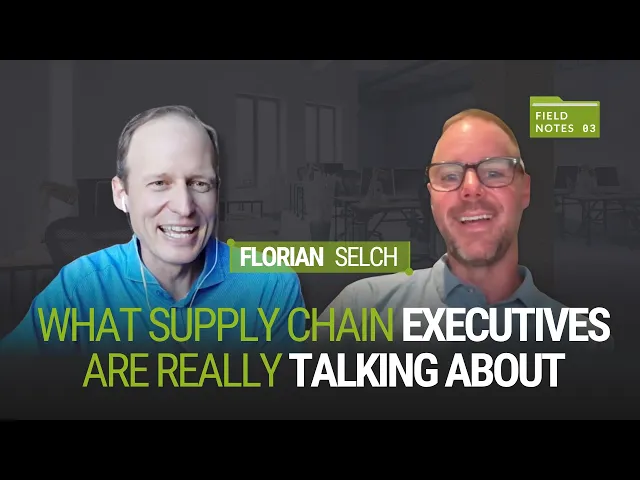
In the full conversation, we cover:
What supply chain executives are hearing from boards and CEOs
Why AI has created both urgency and hesitation
How leaders can evaluate early-stage technology partners
Why supply chain executives may need to think more like investors
How peer-to-peer learning helps close the trust gap
Why automation can either connect or reinforce silos
Why agility may matter more than better forecasts
How to experiment without putting the operation at risk
Final Takeaway
The useful question is not, “Do we have an AI strategy?”
It is, “Do we have a disciplined way to learn which technology bets are worth making?”
That starts with three things: pick one real operating problem, define the risk boundary, and decide what would have to be true before the pilot becomes part of the business.
Technology may change the supply chain, but the work still has to hold up inside the operation.
Stay Connected
Find us @withJunction on YouTube and LinkedIn for more Field Notes episodes, clips, and conversations on distribution, freight, and operations.
Want to be a guest or suggest a topic? Email us at info@withjunction.com.